WHAT YOU CARRY
Featured at the 2026 Canadian CBRNE & Robotics Summit · Instructors: Lyle Renaud · April 21, 2026
IT DOESN'T BILL YOU AT THE SCENE. IT RUNS A TAB.
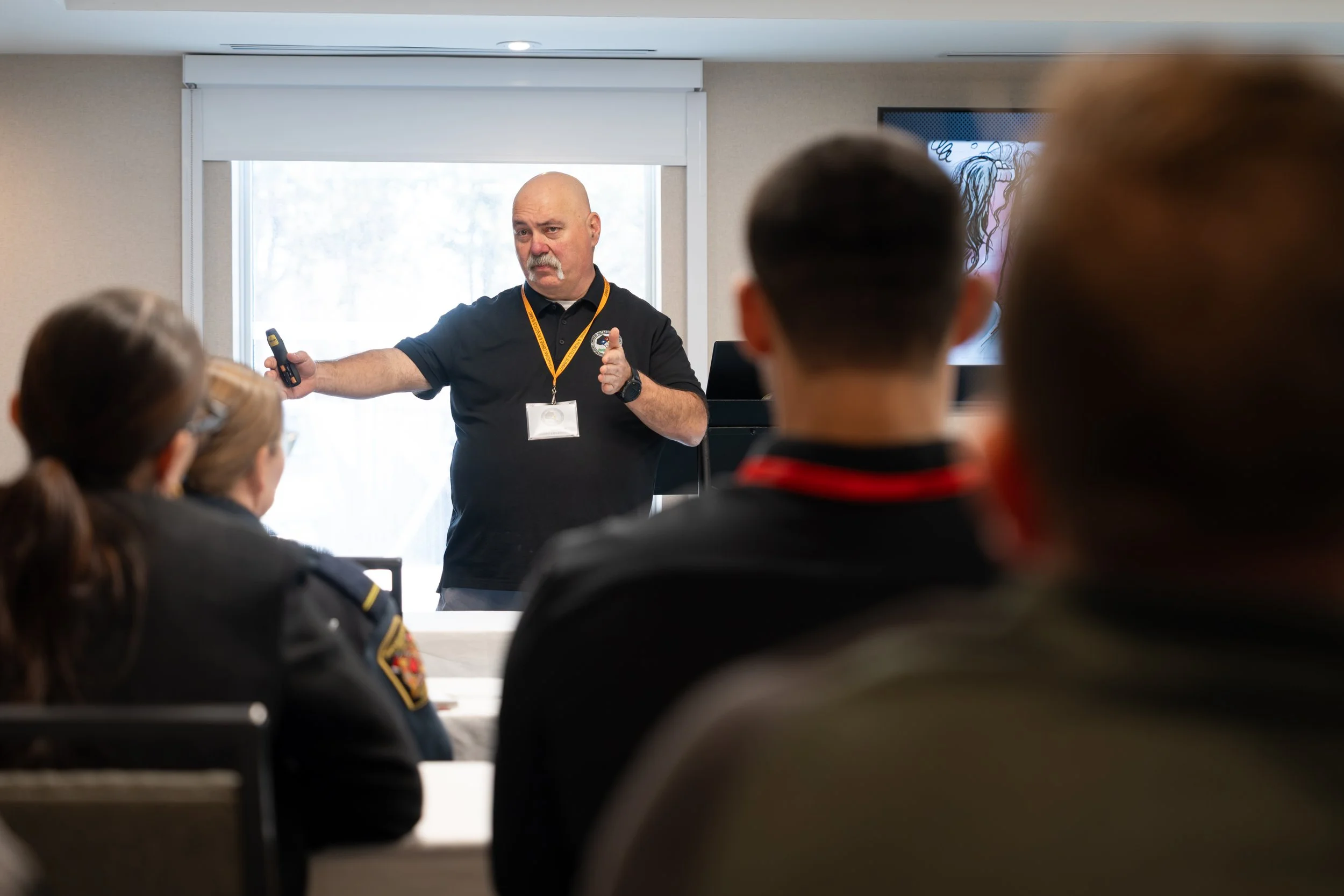
Photograph by DIGRUCC.IO at the 2026 Canadian CBRNE & Robotics Summit
The injury this job leaves isn't always the one you can see — and it's closer to the norm than the exception.
Nobody flags the call that gets them. It's rarely the big one. It's the accumulation — the paediatric arrest you handled clean, then couldn't stop seeing three weeks later. An operational stress injury doesn't bill you at the scene. It runs a tab.
Here's the figure that reframes how common this is.
In the largest Canadian study of public safety personnel — nearly 5,800 people — 44.5% screened positive for at least one mental health disorder, and 23.2% for PTSD. General-population PTSD sits around 9%. So this isn't a fragile minority at the edges of the service. In a truck of four, over a career, the math says it reaches most of the crew.
A few distinctions the culture tends to blur:
PTSD isn't the whole picture. Depression and substance use ride alongside it; in that same body of Canadian research, large shares of responders reported moderate-to-high depressed mood.
Moral injury is its own wound. It's the damage from what you were ordered to do, or couldn't do — not just what you saw. It's distinct from PTSD and routinely missed.
It's delayed. The exposure is cumulative and the symptoms can surface long after the shift that caused them. Feeling fine tonight isn't the all-clear.
Here's what changed in Ontario, and why too few people use it:
Presumptive legislation. Since 2016, an Ontario first responder diagnosed with PTSD no longer has to prove it came from the job — the WSIB claim is presumed work-related. That flipped the burden off the injured responder. Plenty of the people it protects don't know it applies to them.
And here's the case for peer support specifically.
Responders consistently say the clinicians and the EAP help — but what they actually want is help from someone who understands the job, not someone they have to explain it to. Peer support clears the two biggest barriers, stigma and "you don't get it," in a single move. That's the whole point of it.
The thing to un-learn:
Putting up your hand isn't the end of a career. Under presumptive coverage and modern programs, it's treated like the injury it is. For the responders who wait, the silence is usually the bigger threat to the career than the injury ever was.
You'd never walk off a scene on a bleed you could see. This is the one you can't.
If you're carrying something heavy: Boots on the Ground runs a 24/7 anonymous peer-support line for Ontario first responders — police, fire, EMS, corrections — serving and retired: 1-833-677-2668. In crisis, call or text 988 (Suicide Crisis Helpline). Ontario's Warrior Health / Homewood crisis line: 1-833-866-9929.
Sources
44.5% of Canadian public safety personnel screened positive for ≥1 mental health disorder; 23.2% for PTSD (Carleton et al. / CIPSRT, n=5,813) — CIPSRT: https://www.cipsrt-icrtsp.ca/en/panel-discussion-shifting-barriers ; Public Safety Canada PTSI Action Plan: https://www.publicsafety.gc.ca/cnt/rsrcs/pblctns/2019-ctn-pln-ptsi/index-en.aspx
General-population vs. first-responder PTSD prevalence; depressed-mood shares — Road to Mental Readiness meta-analysis (PMC): https://ncbi.nlm.nih.gov/pmc/articles/PMC6591743 ; OSI clinic study (2025): https://journals.sagepub.com/doi/10.1177/11786329251333019
Moral injury as distinct from PTSD — narrative review/meta-analysis (2025): https://www.ncbi.nlm.nih.gov/pmc/articles/PMC12294130/
Boots on the Ground 24/7 line; Warrior Health / Homewood crisis line — Warrior Health (Wounded Warriors Canada / Ontario SolGen program): https://warriorhealth.ca/en/resource/WH68519d496adbc3065635039 ; https://www.bootsontheground.ca/
